

⏫ The Vertical Voyager: Your Ascent to a High-Tech Career as an Elevator Technician
Hello, puzzle solvers and precision experts! Have you ever paused to appreciate the complex machine that effortlessly lifts you hundreds of feet in a matter of seconds? That machine is the modern elevator, and the highly skilled professional who installs, maintains, and, yes, rescues people from it is the Elevator Technician (also known as an Elevator Mechanic or Constructor).
This is a true master trade—a specialty that seamlessly blends mechanical engineering, advanced electronics, and rigorous safety compliance. The Elevator Technician holds one of the most respected and best-compensated positions in the skilled trades, offering incredible job security because every tall building, hospital, and mall relies on their expertise. They work on systems that are literally life-saving, where accuracy and adherence to code are non-negotiable.
We’re stepping into the hoistway to explore this high-value, high-tech profession—dissecting the demanding job description, the intensive apprenticeship required, and the unique combination of technical genius and physical courage that defines this vertical voyager. Get ready for a career with high potential!
⚙️ The Elevator Technician’s Job Description: Guardians of Vertical Mobility
An Elevator Technician is responsible for the entire lifecycle of vertical transportation systems, including elevators, escalators, dumbwaiters, and moving walkways. Their role spans from the construction site installation to the critical 24/7 service and repair of operational units.
Core Responsibilities:
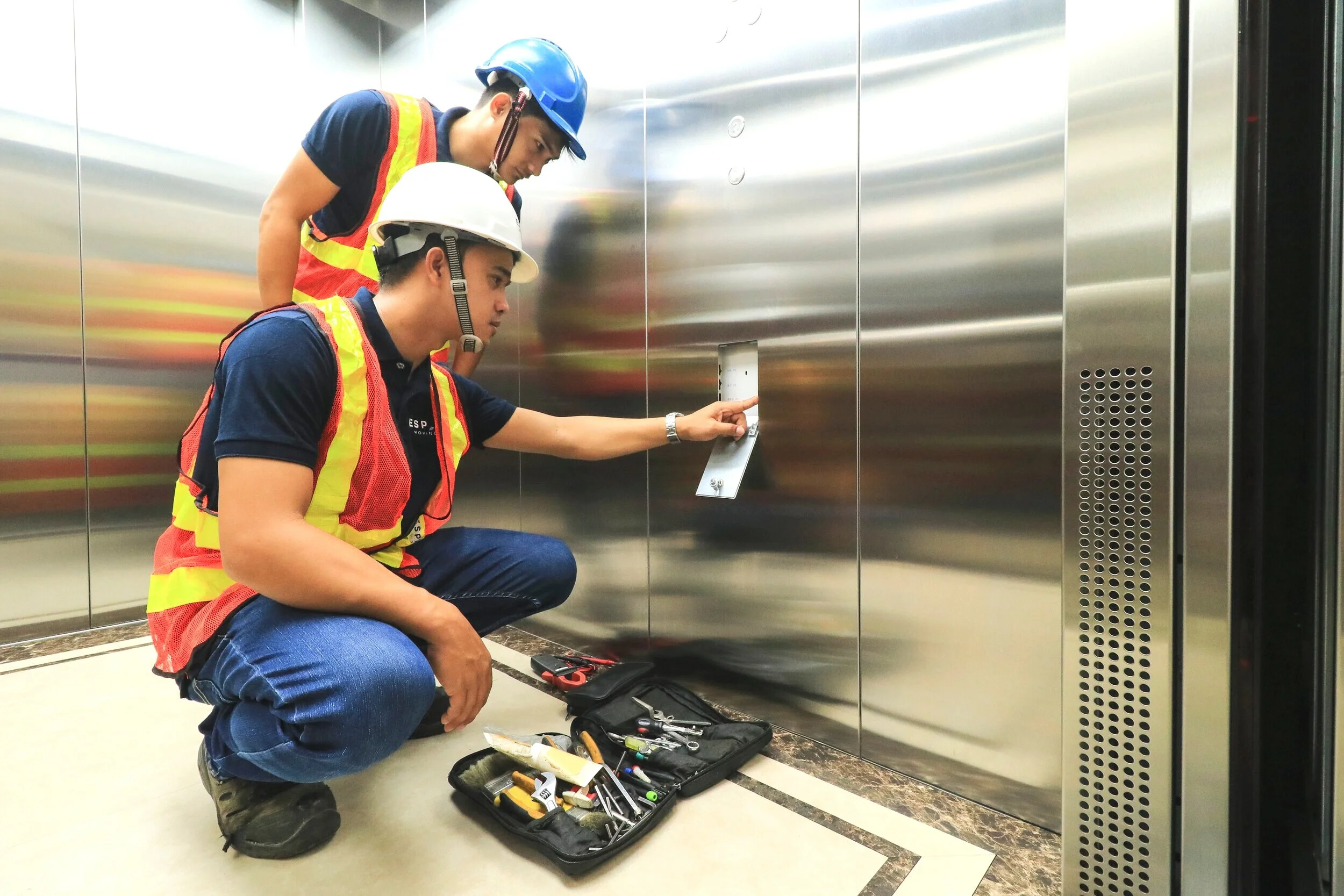
- Installation and Assembly: Installing new elevator systems from the ground up. This involves reading complex blueprints, assembling components like guide rails, motors, counterweights, cabs, cables, and connecting sophisticated control panels and wiring harnesses.
- Preventive Maintenance (PM): Performing routine, scheduled maintenance (lubricating moving parts, checking hydraulic fluid levels, testing door mechanisms, adjusting brake systems) to comply with manufacturer specifications and local safety codes (like ASME A17.1/CSA B44).
- Advanced Diagnostics and Troubleshooting: Utilizing specialized electronic testing equipment (oscilloscopes, meggers, multimeters) to diagnose complex mechanical, electrical, and electronic failures within motors, control boards, Variable Frequency Drives (VFDs), and safety circuits.
- Repair and Modernization: Dismantling and replacing worn or defective components, including ropes, motors, control boards, and microprocessors. They also perform major modernizations to update older systems to meet current safety and efficiency standards.
- Emergency Response: Responding rapidly to emergency breakdowns and entrapment calls, often requiring them to manually override or safely operate the system to rescue passengers and restore service with minimal downtime.
- Code Compliance and Testing: Conducting mandated safety tests and inspections to ensure the elevator meets all local and national building and safety codes. They are often responsible for signing off on critical safety functionality.
- Record Keeping: Maintaining meticulous, detailed service records of all installations, maintenance checks, repairs, and test results for every unit they service.
The Elevator Technician is a multidisciplinary expert—part heavy mechanic, part electronics troubleshooter, and part safety inspector.
🎓 Experience and Qualifications: The Rigorous Path to Mastery
The route to becoming an Elevator Technician is one of the most rigorous and rewarding in the trades, relying on a formal, structured apprenticeship rather than a traditional college degree.
Essential Qualifications:
- High School Education: A High School Diploma or GED is mandatory, typically requiring a strong foundation in math, physics, and basic mechanical/electrical aptitude.
- Apprenticeship Program (The Gold Standard): Entry is overwhelmingly gained through a four- to five-year registered apprenticeship, such as those sponsored by the International Union of Elevator Constructors (IUEC) and the National Elevator Industry Educational Program (NEIEP). These programs are highly selective and involve:
- 8,000 hours of paid On-the-Job Learning (OJL): Working under the direct supervision of a licensed mechanic.
- Hundreds of hours of Classroom Instruction: Covering electrical theory, motor control, hydraulics, physics, rigging, and code application.
- Pre-Apprenticeship Testing: Applicants must typically pass an aptitude test (like the Elevator Industry Aptitude Test or EIAT) that assesses math, reading comprehension, and mechanical reasoning skills.
- Licensure and Certification: Many states and jurisdictions require a specific State Elevator Mechanic License. Industry certifications like the Certified Elevator Technician (CET), offered by the National Association of Elevator Contractors (NAEC), are highly respected and demonstrate proficiency.
- Physical Requirements: The job demands physical strength and stamina, the ability to lift heavy components (sometimes up to 100 lbs or more with assistance), work in cramped spaces (machine rooms, pit areas), and, critically, the ability to work comfortably and safely at extreme heights in the hoistway.
The years spent in the apprenticeship forge a highly disciplined and supremely capable professional.
💡 Special Skills: The Technician’s Elite Toolkit
Success as an Elevator Technician requires more than just knowing where the wires go; it requires an elite combination of mechanical instinct, electronic mastery, and nerves of steel.
Technical & Diagnostics Skills (Hard Skills):
- Integrated Systems Troubleshooting: The ability to understand the complex interaction between the three primary systems: Mechanical (cables, sheaves, doors, brakes), Hydraulic (pumps, valves, fluid control), and Electrical/Electronic (control boards, relays, PLCs, door operators).
- Control Logic Mastery: Expertise in reading and interpreting complex ladder logic and solid-state circuit diagrams to diagnose faults in modern electronic control systems and Programmable Logic Controllers (PLCs).
- Rigging and Hoisting: Advanced practical skills in safely moving and securing extremely heavy components (motors, counterweights) within the confined space of a machine room or hoistway using specialized rigging gear.
- Code Interpretation: Expert knowledge of the ASME A17.1/CSA B44 safety codes is the ultimate rulebook for the industry. The technician is the final line of defense for public safety.
- Blueprint Visualization: The ability to mentally assemble a complex system and visualize the routing of components based solely on two-dimensional blueprints.
Safety & Professional Skills (Soft Power):
- Unwavering Safety Commitment: Operating with a supreme level of safety awareness and adherence to Lockout/Tagout procedures, understanding the extreme danger inherent in working in an open shaft or with high-voltage components.
- Critical Thinking Under Pressure: The capacity to remain calm and systematic while troubleshooting a breakdown, especially during an emergency call-out where people might be trapped. Panic is simply not an option.
- Physical Dexterity and Spatial Awareness: Excellent coordination and awareness are needed to maneuver tools and heavy parts in confined and high-risk spaces.
- Customer Communication: Effectively communicating the technical issue, the repair plan, and the safety status to building managers or homeowners who rely completely on the technician’s expertise.
- Continuous Learning: The industry evolves rapidly with new motor technologies, control systems, and software. A top technician is always investing time in manufacturer-specific training and code updates.
🚀 The Impact: A Career That Goes Up
The Elevator Technician’s career is stable, financially rewarding, and truly essential. With the consistent growth of high-rise construction globally, the demand for these specialists continues to outpace the supply. This is a career where your daily work directly contributes to the smooth, safe operation of civilization’s vertical landscape, offering a deep sense of professional pride and tangible results.
If you have a knack for complex systems, a high tolerance for pressure, and the desire to master an elite trade that quite literally takes you to the top, then the path of the Elevator Technician is your call to action.