

🏗️ The Unsung Movers: Forklift Operator—The Backbone of Modern Logistics
Hello, efficient organizers and champions of the warehouse floor! Ever wonder what keeps those massive logistics centers running like a Swiss watch? The answer rests on the forks of one critical piece of machinery, expertly commanded by the Forklift Operator.
A career as a Forklift Operator (also known as a Powered Industrial Truck Operator or Forklift Driver) is far more than just “driving a truck.” It’s a high-stakes, high-focus job that requires intense spatial awareness, meticulous precision, and an unwavering commitment to safety. You are the heart of the supply chain, responsible for safely moving millions of dollars in inventory every single day.
It’s a stable, in-demand career that offers immediate employment opportunities and serves as the perfect launchpad into advanced roles like warehouse management or logistics supervision. We’re going to lift the lid on this essential profession—exploring the critical job description, the mandatory training and certification needed, and the specialized skills that transform a driver into a master material handler. Let’s get moving!
📦 The Forklift Operator’s Job Description: Precision in Motion
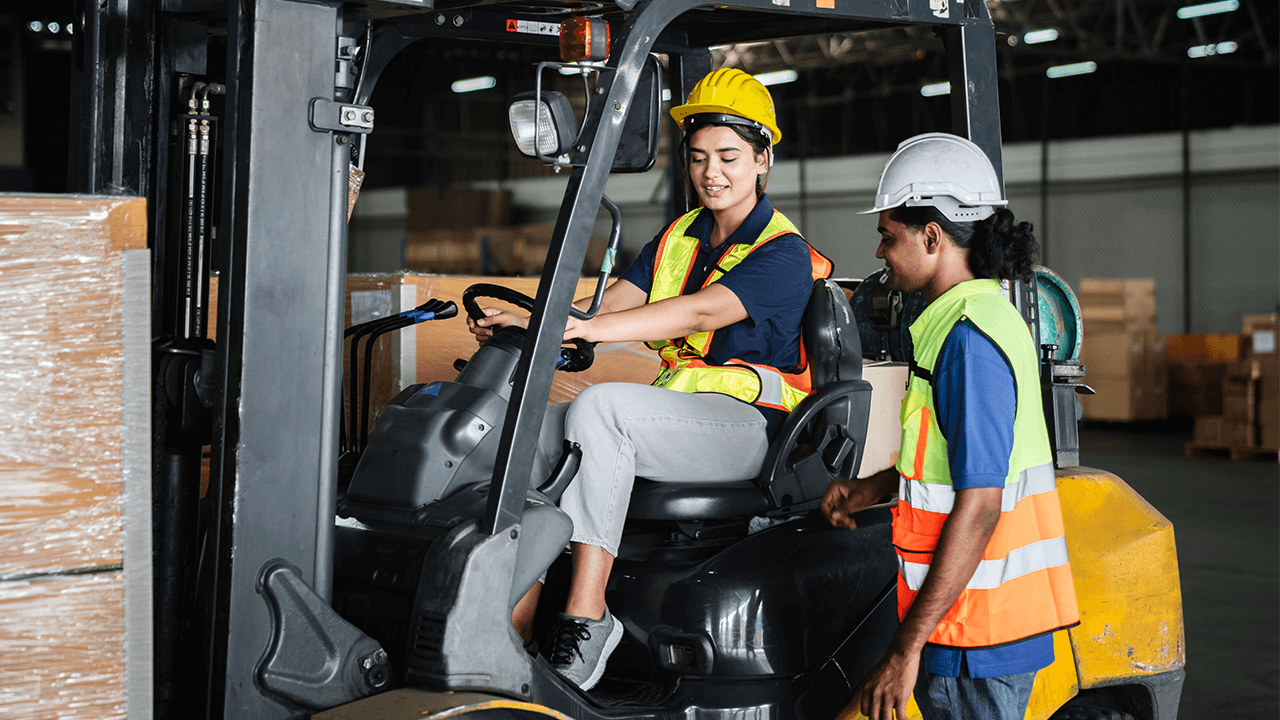
A Forklift Operator is the professional responsible for safely and efficiently moving, stacking, and organizing goods and materials within a warehouse, manufacturing facility, distribution center, or construction site. Their work directly affects inventory accuracy, production flow, and overall safety.
Core Responsibilities:
- Loading and Unloading: Using the forklift to safely load materials and merchandise onto outgoing trucks and to unload incoming vehicles (tractor-trailers, rail cars, etc.). This requires expert judgment to ensure the load is balanced and secured.
- Material Transport and Staging: Transporting raw materials to production lines, moving finished products to shipping areas, and staging orders for dispatch.
- Stacking and Retrieval: Locating and retrieving specific stock items from high shelving and accurately stacking pallets in designated storage bays, strictly following inventory and rotation procedures (First-In, First-Out or FIFO).
- Safety and Inspection: Conducting mandated pre-shift inspections (pre-ops or daily checks) of the forklift—checking brakes, tires, horn, fluid levels, and hydraulic controls—and immediately reporting any mechanical faults or damage.
- Inventory Control: Utilizing Radio Frequency (RF) scanning equipment or handheld devices to scan, track, and record the movement of goods, ensuring real-time inventory accuracy. They must also report any product damage or stock shortages.
- Compliance: Adhering strictly to all workplace safety guidelines, traffic rules, and especially the Occupational Safety and Health Administration (OSHA) or equivalent local standards regarding powered industrial trucks.
- Workplace Order: Actively helping to maintain a clean, organized, and hazard-free warehouse environment by clearing debris and ensuring safe passageways for pedestrians and other equipment.
The Forklift Operator’s role is one of immense responsibility, where a single mistake can lead to catastrophic accidents, significant product damage, or major operational delays.
🎓 Experience and Qualifications: Safety is the Foundation
Unlike many professions, the path to becoming a Forklift Operator does not require a college degree. It is a trade built on formal training, mandatory certification, and supervised practical experience.
Essential Qualifications:
- Minimum Age: Operators must generally be 18 years or older due to federal regulations concerning powered industrial trucks.
- Education: A High School Diploma or GED is typically preferred by most employers, demonstrating basic literacy and mathematical skills needed for reading instructions and inventory sheets.
- Mandatory Certification (The Key): The most critical requirement is a Valid Forklift Operator Certification, which is mandated by OSHA (in the U.S.) and similar regulatory bodies worldwide. This certification involves three main components:
- Formal Instruction: Classroom or online training covering safety regulations, operating procedures, hazard identification, and load stability theory.
- Practical Training: Hands-on experience under the direct supervision of a qualified trainer.
- Performance Evaluation: An employer-led assessment to confirm the operator can safely and proficiently operate the specific class of forklift they will be using in the actual workplace environment.
- Physical Condition: Excellent physical condition and coordination are essential, including good eyesight, peripheral vision, depth perception, and the ability to frequently sit, stand, and lift materials up to 50 pounds.
- Driver’s License (Often Required): While a standard driver’s license is not the same as forklift certification, many employers require a valid driving license for general site purposes.
- Prior Warehouse Experience (Valuable): Previous experience in a warehouse, logistics, or production environment provides a strong advantage, as it shows familiarity with the operational pace and safety culture.
Certification is generally machine-specific (e.g., counterbalance, reach truck, turret truck), making continuous training and re-certification (typically every three years) mandatory.
💡 Special Skills: The Operator’s Unique Toolkit
A truly exceptional Forklift Operator possesses a distinct set of technical and spatial skills that elevate their work beyond simple driving.
Technical & Spatial Skills (Hard Skills):
- Spatial Relations and Depth Perception: Elite operators have an excellent, almost intuitive, sense of spatial awareness—judging the precise distance, angle, and clearance needed to maneuver forks and loads in tight aisles or around corners without striking shelves or other equipment.
- Load Stability Mastery: Deep understanding of the load triangle and the 24-inch load center rule. They know how different loads (unsecured, oversized, wet, or uneven) affect the forklift’s center of gravity and safe capacity.
- Systematic Pre-Operation Check: The discipline to perform a thorough, detailed pre-op inspection daily, catching potential malfunctions before they become catastrophic equipment failures.
- Inventory Technology Proficiency: Competency in using specialized warehouse management systems (WMS) via RF scanners or tablets to precisely locate, transfer, and verify materials, making them integral to inventory accuracy.
- Basic Mechanical Aptitude: The ability to perform minor maintenance (e.g., checking battery water, monitoring fluid levels) and to accurately report equipment issues for timely repair.
Professional & Safety Skills (Soft Power):
- Safety-First Mentality (Non-Negotiable): An unyielding commitment to OSHA and company safety policies. This includes maintaining safe speeds, sounding the horn at blind corners, and always yielding the right-of-way to pedestrians.
- Extreme Attention to Detail: Essential for accurate inventory management (ensuring the correct SKU is pulled) and quality assurance (identifying and reporting damaged goods).
- Focus and Composure: The capacity to maintain intense concentration for long periods in a noisy, fast-paced environment while avoiding complacency.
- Teamwork and Communication: The ability to communicate clearly and calmly with supervisors, loaders, and ground staff—often using two-way radios—to coordinate material flow and ensure pedestrian safety.
- Patience and Smooth Operation: The realization that speed is less important than smoothness and control. Jerky movements cause load shifts and increase the risk of tip-overs.
🚀 The Impact: More Than Just Driving
The Forklift Operator is an essential worker in the global economy. They are the human element that prevents bottlenecks in the entire chain of commerce. This career offers outstanding stability, often with competitive wages and benefits. Furthermore, mastering the operator role is the first step toward becoming a Lead Operator, Warehouse Supervisor, or Logistics Manager, making it a truly rewarding entry point into the supply chain industry.
If you are precise, safety-minded, have great hand-eye coordination, and want a career where your expertise literally moves the world, then getting your Forklift Operator Certification is your first gear shift into success.