


🥶 The Cold Hard Facts: Mastering the High-Demand Career of a Refrigerator Technician
Hello, troubleshooting titans and coolness connoisseurs! When your refrigerator suddenly stops humming, or your commercial freezer turns into a puddle, panic sets in. That moment of crisis is when the true hero arrives: the Refrigerator Technician (a specialized branch of the HVAC-R field).
A Refrigerator Technician is not just a repair person; they are a scientist, an electrician, a plumber, and a vital guardian of food safety and comfort. In a world dependent on cold storage—from your home fridge and grocery store displays to massive industrial cold rooms—this career offers incredible job security, constant technical challenges, and the satisfaction of mastering complex thermodynamic principles.
We’re opening the service panel on this essential trade. Get ready to explore the precise job description, the specialized training and certifications required, and the unique blend of technical smarts and hands-on skill that defines a top-tier Refrigerator Technician. Prepare for a career that’s always in demand!
❄️ The Refrigerator Technician’s Job Description: The Keeper of the Cold Chain
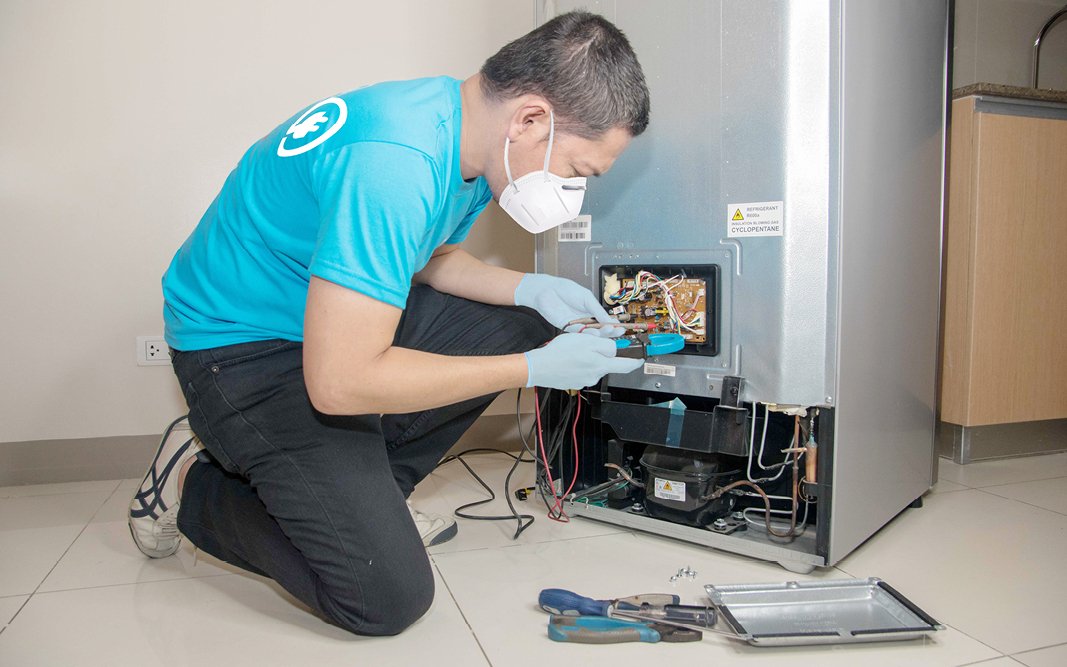
A Refrigerator Technician (sometimes called a Refrigeration Mechanic or Commercial HVAC-R Tech) is specifically focused on the installation, preventive maintenance, repair, and diagnostics of refrigeration and cooling systems. Their work ensures temperature-sensitive goods—whether food, medicine, or industrial components—are preserved safely.
Core Responsibilities:
- Diagnostics and Troubleshooting: Using sophisticated diagnostic tools (like thermometers, gauges, multimeters, and leak detectors) to meticulously pinpoint the source of electrical, mechanical, or refrigerant-cycle faults in various cooling units.
- Installation and Commissioning: Installing new refrigeration equipment, which involves calculating load requirements, running electrical circuits, installing copper piping, wiring controls, and thoroughly testing the system upon completion.
- Preventive Maintenance (PM): Performing routine, scheduled maintenance to maximize the efficiency and lifespan of units. This involves cleaning coils, checking fan motors, lubricating parts, and ensuring proper airflow and temperature settings.
- Refrigerant Handling and Compliance: Safely handling, recovering, recycling, and charging various types of refrigerants. This work must be executed in strict compliance with federal and environmental regulations, particularly those set by the EPA.
- Repair and Component Replacement: Repairing or replacing malfunctioning system components such as compressors, condensers, evaporators, thermal expansion valves (TXVs), heat exchangers, and complex digital control boards. This requires expertise in electrical wiring and often intricate brazing or welding of copper lines.
- Customer/Client Communication: Clearly explaining complex, often urgent, technical issues, repair options, costs, and preventative measures to homeowners, restaurant managers, or facility engineers.
- Documentation and Record Keeping: Maintaining accurate, detailed records of service calls, diagnostic findings, repairs performed, parts used, and refrigerant tracking for legal compliance and warranty purposes.
- Safety Compliance: Adhering strictly to all safety protocols, especially when dealing with high-voltage electricity, pressurized refrigerants, and working in potentially hazardous environments like commercial kitchens or industrial plants.
The Refrigerator Technician is the specialist who guarantees the integrity of the “cold chain,” where temperature control is critical to health and commerce.
🛠️ Experience and Qualifications: The Trade of Precision
Like other specialized trades, the path to becoming a Refrigerator Technician requires focused technical education, followed by extensive, supervised practical training.
Essential Qualifications:
- Education: A High School Diploma or GED is required, supplemented by a Certificate or Associate’s Degree from an accredited technical or trade school in HVAC-R (Heating, Ventilation, Air Conditioning, and Refrigeration) Technology. These programs provide the foundational knowledge in thermodynamics, electrical circuits, and pipefitting.
- Apprenticeship/Field Experience: Practical experience is paramount. Technicians typically complete a structured 3-to-5-year apprenticeship under a licensed Refrigeration Mechanic or through a union program, gaining thousands of hours of crucial hands-on training.
- EPA Section 608 Certification (Mandatory for US): This certification, issued by the Environmental Protection Agency, is a legal necessity for anyone working with regulated refrigerants. You must be certified to handle these chemicals.
- Manufacturer-Specific Training: Specialized training from major refrigeration equipment manufacturers (e.g., walk-in freezers, ice machines, chillers) is highly valued and often required for servicing proprietary commercial systems.
- State or Local Licensing: Many jurisdictions require additional professional licensing or examination to practice independently as a certified Refrigeration Technician or Master Contractor, usually after accumulating several years of field experience.
- Valid Driver’s License: Necessary for responding to service calls across various commercial and residential locations.
The career demands a commitment to technical excellence and a willingness to stay updated on ever-changing equipment and environmental regulations.
💡 Special Skills: The Diagnostic Edge and the Art of the Fix
A top-tier Refrigerator Technician is defined by a sophisticated set of diagnostic abilities and the practical dexterity to execute precise repairs.
Technical & Diagnostics Skills (Hard Skills):
- Refrigeration Cycle Mastery: A deep, intuitive understanding of the complex four-step refrigeration cycle and the ability to diagnose faults within each stage using specialized instruments like manifold gauges and superheat/subcooling calculators.
- Advanced Electrical Troubleshooting: Expertise in tracing high-voltage and low-voltage control circuits, reading complex wiring schematics, and safely diagnosing components like three-phase motors and complex digital controllers.
- Brazing and Welding Proficiency: The non-negotiable skill of joining copper lines with precise, leak-proof brazing to maintain the integrity of the sealed refrigerant system.
- Thermodynamics and Physics: Applying fundamental knowledge of heat transfer, pressure, and temperature relationships to accurately assess system performance and calculate optimal refrigerant charge.
- Blueprints and Schematics: The ability to read, interpret, and work from detailed technical manuals and facility blueprints, especially for large industrial or commercial systems.
Professional & Emergency Skills (Soft Power):
- Systematic Problem-Solving: The ability to approach a complete system failure with calm logic, testing variables sequentially (electrical, mechanical, refrigerant charge) to isolate the single, root cause—avoiding costly “guesswork” repairs.
- Acute Attention to Detail: Essential when dealing with minute refrigerant leaks, delicate control wiring, or precise temperature calibration. Small errors have big consequences in a sealed system.
- Customer Service and Urgency: Understanding that a broken commercial freezer is a business emergency. Providing clear, empathetic communication and prioritizing calls based on critical need (e.g., medical refrigeration vs. residential fridge) is vital.
- Physical Endurance and Dexterity: The capacity to work with heavy machinery, lift compressors, maneuver in tight spaces (like crawl spaces or behind equipment), and use fine motor skills for intricate wiring and brazing.
- Independent Work Ethic: Often working alone on client sites, the technician must manage their time effectively, maintain professional conduct, and complete complex diagnostics and repairs without direct supervision.
🚀 The Impact: Essential to Health, Safety, and Commerce
The career of a Refrigerator Technician is one of high necessity. They service the critical infrastructure that supports supermarkets, hospitals, restaurants, food processing plants, and pharmaceutical facilities. The demand for skilled technicians is consistently high, driven by the increasing complexity of systems and the need for energy efficiency.
If you possess a logical mind, enjoy technical puzzles, thrive in a hands-on environment, and want a career that directly contributes to public health and economic stability, then mastering the trade of a Refrigerator Technician is an incredibly smart, secure, and rewarding choice.