

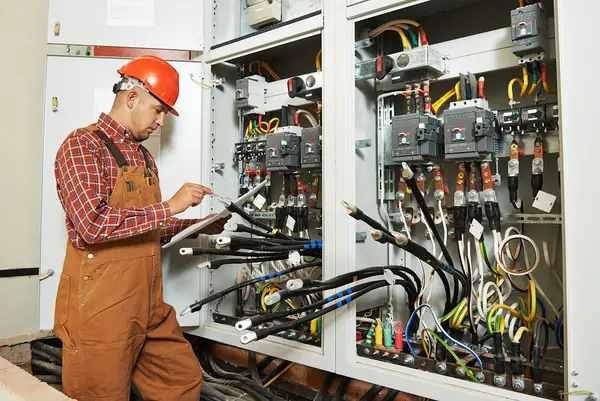

⚡ The Architects of Power: Illuminating the World as an Electrical Engineer
Hello, future innovators and problem-solvers! Have you ever paused to think about what makes modern life possible? The smartphone in your hand, the renewable energy grid powering your city, the advanced robotics in a factory—all of it traces back to the genius of the Electrical Engineer.
This isn’t just a job; it’s a relentless pursuit of efficiency, safety, and innovation at the speed of light. Electrical Engineering is the bedrock of nearly every industry on the planet, offering a dynamic, challenging, and profoundly impactful career path.
We’re flipping the switch to explore what an Electrical Engineer truly does, the rigorous education required, and the unique skills that turn a bright graduate into a legendary designer of the future. Get ready to electrify your career aspirations!
💡 The Electrical Engineer’s Job Description: Designing the Current of Tomorrow
The Electrical Engineer (EE) applies the principles of electricity, electronics, and electromagnetism to design, develop, test, and manage the deployment of electrical equipment and systems. Unlike electronic engineers, who often focus on micro-components (like microchips), EEs traditionally work on the large-scale application of power—from massive power grids and electric vehicle systems to complex building services.
The job is a fusion of theoretical knowledge, hands-on testing, and complex project management.
Key Responsibilities:
- Design & Development: Design new or improved electrical systems, components, and equipment, such as motors, power generation apparatus, wiring systems, or controls. This involves creating detailed schematics, blueprints, and specifications using Computer-Aided Design (CAD) software.
- System Analysis & Testing: Conduct rigorous analysis, modeling, and simulation (using tools like MATLAB or PSpice) of designs to ensure safety, reliability, and optimal performance before a prototype is even built. Once built, they design and oversee comprehensive testing procedures.
- Project Management: Manage projects from conception to completion—this includes calculating project costs, estimating timelines, managing budgets, and overseeing technicians and installation teams.
- Compliance and Safety: Ensure that all designs and installations strictly comply with national and local electrical codes, safety regulations (like NEC), and industry standards. Safety is paramount when working with high-voltage systems.
- Troubleshooting and Maintenance: Diagnose complex failures or malfunctions in existing systems and design solutions to correct them, ensuring minimal downtime and long-term operational integrity.
- Collaboration: Work collaboratively with multidisciplinary teams, including Mechanical Engineers, Civil Engineers, Software Developers, and non-technical clients, to integrate electrical systems into larger projects (e.g., a power plant or a smart building).
An Electrical Engineer is ultimately responsible for ensuring that power is generated, controlled, and delivered reliably, safely, and efficiently across all scales of application.
🎓 Experience and Qualifications: The Educational Blueprint
Entry into the world of Electrical Engineering is built on a strong, specialized academic foundation combined with practical, real-world experience.
Foundational Qualifications:
- Bachelor’s Degree (Non-Negotiable): A Bachelor of Science (B.S.) in Electrical Engineering (BSEE) or a closely related field (like Electronic Engineering, Power Engineering, or Electromechanical Engineering) from an accredited program (e.g., ABET accredited in the US) is the standard entry requirement.
- Advanced Degree (Highly Valuable): A Master’s degree (M.S. or MEng) is increasingly common, especially for specialized, advanced, research-focused, or senior-level roles, offering greater specialization in fields like power systems, control systems, or telecommunications.
- Internships and Co-op Programs: Practical, hands-on experience gained through internships or cooperative education programs is crucial. Employers look for candidates who have applied theoretical knowledge in a professional setting.
- Professional Engineering (PE) License: While not required for entry-level roles, obtaining a Professional Engineer (PE) license (after typically passing the Fundamentals of Engineering (FE) exam, gaining several years of experience, and passing the Principles and Practices of Engineering (PE) exam) is critical for engineers who approve designs, manage public projects, or become consultants.
The educational path is rigorous, focusing heavily on mathematics, physics, circuit theory, and electromagnetism.
🛠️ Special Skills: Powering the Professional Engineer
Beyond the formal education, certain technical and interpersonal skills transform an academic Electrical Engineer into an industry leader. These are the soft and hard skills that define an engineer’s true capability.
Technical Skills (Hard Skills):
- Circuit Analysis and Theory: A deep, intuitive understanding of circuit theory, including AC/DC analysis, control systems, power electronics, and signal processing.
- Software Proficiency: Expertise in industry-standard tools:
- CAD/Design: AutoCAD Electrical, SolidWorks Electrical.
- Simulation/Analysis: MATLAB, Simulink, PSpice, or specialised power system software.
- Programming: Basic proficiency in languages like Python or C/C++ is often required, particularly in embedded systems or industrial automation (PLC/SCADA).
- Testing and Measurement: Hands-on experience with laboratory equipment like oscilloscopes, multimeters, function generators, and spectrum analyzers for prototyping and troubleshooting.
- Code Mastery: Intimate knowledge and practical application of relevant electrical codes (e.g., NEC, IEC) and safety standards.
Professional Skills (Soft Skills):
- Analytical and Problem-Solving Mindset: The ability to approach complex, ambiguous technical issues, break them down into manageable parts, and derive logical, compliant, and cost-effective solutions. This is the core of engineering.
- Attention to Detail: In electrical work, a single misplaced wire or calculation error can have catastrophic consequences. Meticulous attention to detail is essential for safe and reliable designs.
- Communication Skills: Engineers must clearly articulate complex technical information to non-technical stakeholders (clients, managers, sales teams) and effectively communicate specifications and instructions to technicians and construction crews.
- Project Management: The ability to plan, organise, and execute multiple design phases simultaneously, manage resources (time, money, materials), and meet strict deadlines.
- Teamwork and Collaboration: Working effectively in multidisciplinary teams, respecting the input of others (civil, mechanical, software), and integrating different system requirements harmoniously.
🌐 The Impact: Powering the Modern World
The Electrical Engineer is not a figure in the background; they are the driving force behind the electrification of transportation, the transition to renewable energy sources (solar, wind), the infrastructure for smart cities, and the automation of manufacturing. Every time you flip a light switch, charge a device, or see a traffic light change, you are experiencing the direct, indispensable work of an Electrical Engineer.
If you are someone who thrives on challenge, has a passion for physics and mathematics, and wants a career where your designs literally power progress, then a future as an Electrical Engineer is waiting for you. It’s a stable, lucrative, and continuously evolving field where yesterday’s theory is today’s infrastructure.